- The Bat Signal
- Posts
- Championship recap: Defense wins championships
Championship recap: Defense wins championships
GOTHAM FC ARE YOUR 2025 NWSL CHAMPIONS!!!!!!


Bat Signal & Anumita Jain
December 17, 2025

Gotham FC were crowned the 2025 NWSL Champions a couple of weeks ago after the Bats took down the Washington Spirit 1-0 in regulation time to earn their second championship in 3 years. Bruninha became just the third player to ever record an assist in an NWSL championship game as a substitute, and her play was topped off with a rocket from Championship MVP Rose Lavelle just outside of the penalty box. The championship win topped off perhaps the most impressive playoff run in NWSL history, with Gotham taking down the best team in regular season history, the defending champions, and their very worthy rivals to lift the trophy. What made this win possible? Let’s get into it.
High press and a smart attack
Gotham made their intentions for this game clear very early. The team’s first shot came from just the second touch of the game, with Jaedyn Shaw going directly for goal right at kickoff.

Although her shot ended up wide of goal, the Bats sent a clear message with this aggressive approach—they were going to play with pressure and take any attacking opportunity they got.
Their next big moment came in the 5th minute, when Gotham got the ball in the back of the net for the first time but the goal was ultimately called offside.

Had Esther not been a touch offside at the time of Jaedyn Shaw’s would-be assist, this would’ve been a great goal. What stands out to us more here, however, is the buildup.

As most Gotham plays do, this one starts all the way back at the feet of Ann-Katrin Berger. She goes left to Jess Carter, who kickstarts a series of long and direct vertical passes to quickly move the ball forward. The Bats have indulged in this style of play a little more this season than in years past, but it’s still pretty uncharacteristic for this side.
The quick vertical passes get the ball into the attacking third, but Gotham’s play doesn’t stop there. The final vertical movement (Jaedyn Shaw’s pass into the penalty area) was intercepted by a Spirit defender, but Gotham quickly transitioned to a phase of winning second and third balls to maintain pressure on Washington’s defense.

The Bats’ play here epitomizes what Emily Sonnett meant in post-match media appearances when she said, “The first 15 minutes, they didn’t really have an answer for it.” Gotham made slicing through the Spirit’s defense look easy, culminating in Midge Purce effortlessly getting around her defender out wide and finding herself still open just outside of the six-yard box. This effort ultimately does not find the back of the net, but yet again Gotham was able to get a hold of second balls and this tenacity results in the goal that got called offside.
In the first half, Gotham had 43% more final third entries than the Washington Spirit, and a lot of this came from more direct play. In the quarterfinal against Kansas City, Rose Lavelle and Sarah Schupansky combined for 4 passes that went directly into the final third. In the final against Washington, the pair completed 12 such passes. If we look at Rose Lavelle’s passing from these two games, her passes in the final against the Spirit were a lot more forward, with 4 times as many progressive passes.
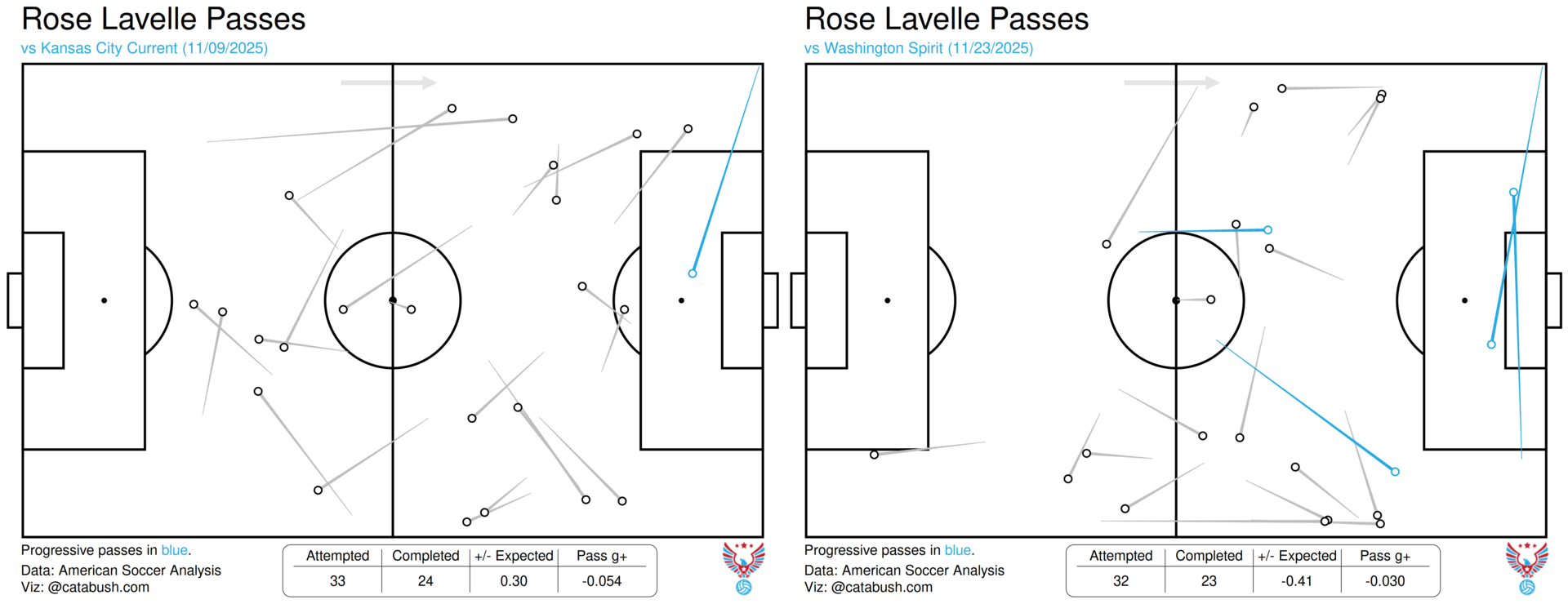
Pass charts courtesy of American Soccer Analysis’s Data Visualization Hub.
Gotham knew that the Spirit were going to require a lot of effort in defense, and so with that their attacking strategy shifted to a more direct and opportunistic approach in addition to their usual strategy of having the forward line press high to force turnovers in dangerous areas.

Here we see both aspects at play—first, Jaedyn Shaw and Esther work together to force a turnover that leaves Shaw with the ball at her feet and space to shoot (albeit from a very far distance). After a one-shot-on-target, 0.1 xG performance against the Orlando Pride the week before, Gotham’s focus shifted back to attacking the goal, and they did not hesitate to take any opportunity to do so. Shaw’s effort here ended up generating 0.02 xG, 0.07 PSxG, and the first save of the match, but it still did much more good than harm. It rattled the Washington defense and showed the opponents that the Bats were here to play and take any opportunity they got, even if they had to manufacture them themselves.
Gotham were successfully prolific in this game, with their more direct approach producing 12 separate shots compared to the 5 that they mustered in the previous game against Orlando. However, 8 of those 12 shots measured at 0.05 xG or lower, so while the quantity was there, there was still room for improvement in quality. But in a cagey game like this where defense reigned, Gotham only needed one of their shots to go through, and the dam finally broke in the 80th minute.

There’s a lot to break down here. The play initially starts out from the back, but quickly becomes very vertical as Sarah Schupansky delivers an absolutely brilliant ball across the pitch into the space in front of Bruninha’s run. Speaking to the media after the game, Bruninha mentioned talking to Jess Carter about how the Spirit defender assigned to her seemed to be getting fatigued and suggesting that the Bats focus on attacking that side. So while this may have seemed like an isolated moment of luck where the ball happened to find the back of the net, there still was a lot of smart play and premeditation that made it possible.
Bruninha took advantage of this insight she gleaned and bought herself a few seconds of time with a few stepovers inside of the box while inching ever so closer to the six-yard box. Off the ball, Gotham had three other attackers (Shaw, Purce, Esther) in the box and the Spirit had five other defenders who were attempting a formation that managed to double team each of the attackers, including Bruninha. As Bruninha completed her stepovers, the attackers (and consequently the defenders) drifted closer to the left side of the penalty box, leaving a wide open space for Rose Lavelle to run into on the right side.
It’s no secret that Gotham asks its players to skip the first attacker when crossing the ball across the box, but in this instance the first, second, and third attackers let the ball go. This confused the already fatigued back line, and by the time the team realized where Bruninha’s clever pass across the top of the box was headed, Hal Hershfelt, who had returned to the pitch seconds earlier after a painful-looking ankle injury, was the only defender who had a chance of intercepting it. Hershfelt was unable to pivot in time to intercept the ball, and Rose Lavelle stepped up to turn a 0.09 xG chance into 0.62 PSxG and most importantly, a goal just outside of the reach of Spirit goalkeeper Aubrey Kingsbury. With 10 minutes and change left in regulation time, thanks to Ann-Katrin Berger, Emily Sonnett, Sarah Schupansky, Bruninha, Jaedyn Shaw, Midge Purce, Esther González, and of course Rose Lavelle, Gotham was up 1-0 in the NWSL championship game.
In the attack, the Bats struck a beautifully functional balance of adapting to the needs of this game (playing more direct), adjusting from their shortcomings in the previous game (playing on the front foot and creating more chances), and playing a smart game (reacting to game state and picking their moments), and boy did it pay off.
An all-consuming defense
The Washington Spirit came into this game on the heels of a 2-0, 3.3 xG win over the Portland Thorns in the semifinals. Their attack was finally clicking, and its pieces were only getting healthier ahead of the matchup against the Bats, with USWNT star Trinity Rodman able to play nearly an entire half and winger Rosemonde Kouassi looking stronger and scarier than ever before. The Spirit’s attack flows through its speedy wingers, and because of that, it was very important that Gotham shut down the Spirit’s wing play before it even had the chance to start. With that in mind, head coach Juan Carlos Amorós opted to bench Bruninha in favor of the more defensive Mandy Freeman on the right side, and have Gotham’s left back Lilly Reale push forward instead, a departure from the way most of the season had gone.
Despite the new strategy, Gotham’s defense really stepped up in the team’s biggest game of the season. The Bats limited their opponent to zero (0) shots on target all game, marking the third such occasion for Gotham this season (the other 13 teams in the league combined for just 2 matches with the same outcome). Gotham’s shut-down defense not only prevented quality shots, but also absorbed Spirit attacks before they even had a chance to get anywhere. Most of this game took place in the middle third of the pitch for both teams (42.2% of Gotham’s touches and 43.3% of Washington’s touches took place here), but only 18.8% of the Spirit’s touches made it to the final third, compared to 23.6% of Gotham’s.
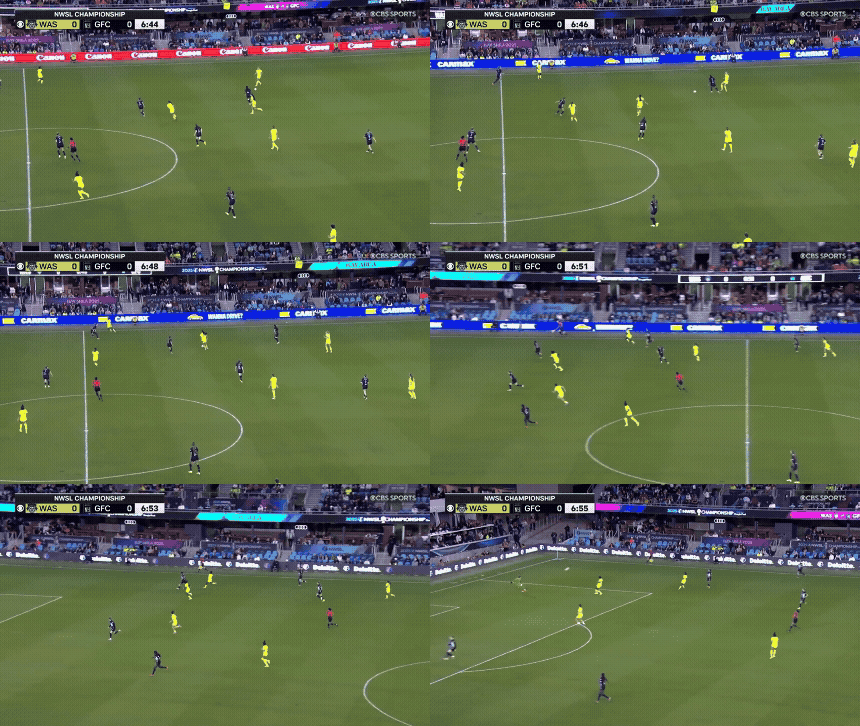
Here we see an example of some of the proactive defending from Gotham that allowed them to have such command over this game. Although Washington broke through a few lines without getting dispossessed by the Bats, Jess Carter was able to read their pass forward to the right side winger perfectly and calmly intercept it before the Spirit could attack Gotham’s back line with their speed.
On the occasion that the Spirit made it into the box and got in a good shooting position, Gotham’s defenders still kept danger at bay by perfectly reading their opponents’ movements and intercepting the ball before a shot could come off.

And when a shot did make its way off a Spirit player’s foot, defenders still made sure it didn’t make it into the back of the net, by any means possible.

And then finally, after their go-ahead goal, Gotham did all they could to limit the Spirit’s chances with 15 or so minutes left to hold a 1-0 lead. Despite the majority of this phase of the game taking place in the Spirit’s attacking half, the Bats only allowed 1 shot, a 0.05 xG chance that came from a free kick set piece that started not too far from the halfway line. The Bats threw numbers back, with every player committed to defense, and stayed sharp while the Spirit’s desperation and fatigue made them sloppy. In this period, despite Washington using all of their energy and numbers to go forward, Gotham earned 2 throw-ins and 5 (!!) free kicks, and even managed to move the ball into their own attacking half 7 separate times.
After falling to the Spirit in penalties in last year’s semifinal, Gotham finished off the 2025 season with 4 shutouts in 4 games played against this opponent. Not too shabby against our budding rivals.
Defense wins championships, and although Gotham did a lot of things right in this match, it’s undeniable that their defense was what led to them lifting the trophy that night.
Control
Overall, Gotham exercised a great deal of control over the pitch in this match.

Graphic courtesy of NWSL Analytics on Bluesky.
The Bats had the most control over the pitch that we’ve seen all season, and this idea passed the eye test too, as Gotham seemed to be the more successful side at executing their own game plan. Gotham was able to implement their press while also dismantling the Spirit’s own press with ease. This was particularly significant for a team whose Achilles’ heel this season seemed to be defending a high press.

And while this wasn’t the most exciting match in terms of attack generated, Gotham still maintained the lion’s share of attacking momentum throughout the game.

Attack momentum chart courtesy of Sofascore.com. While the Spirit were able to generate some attack, they had far fewer moments of high intensity than Gotham.
While this (or any of the other playoff games) wasn’t the most beautiful game of football to ever be played, what the Bats have been so successful at this post-season has been understanding what they need to do to neutralize each opponent and doing exactly that. Gotham’s cumulative xG differential during the playoffs came out to -1.48, and yet they outscored their opponents 4-1.
Immense credit is due to both the coaching staff for coming up with game plans that resulted in wins and to the players for having the skills and soccer IQ to implement these plans and turn them into a championship win. Gotham may not have faced the best possible version of the Washington Spirit, or of the Orlando Pride or the Kansas City Current, but it still takes intelligence and technique to know how to exploit the specific weaknesses of your (still very formidable) opponents and turn them into wins for yourself.
At the end of the day, soccer is about playing the hand you’re dealt and about ending with a winning scoreline, and Gotham did that 3 times in a row when it mattered the most. So for that reason, we have nothing but praise for this team and this coaching staff that did exactly what they were hired to do better than any other team in the league could.
And they managed to do it while prioritizing the people around them, as head coach Juan Carlos Amorós noted that, “What we try to do, or the way I try to do things, is create an environment where people enjoy, where people are happy, where people are taken care of as people before they are players.” Gotham FC is the prime example of how a club should be run, and we are so proud to be able to write about this team.
Speaking on his feelings at the final whistle, Amorós said that, “When you get older, like I am getting now because I’m 41, you start realizing there are certain moments in your life that stick with you forever. You have to understand that those moments will stay with me, but they will stay with them forever. Lilly Reale will be 60 and she will talk about this day. Unfortunately, I lost my dad, and you start seeing perspective in life and things like that. I think creating moments like that for other people is something that makes me really happy. So that’s what I felt in that moment.”
Looking ahead to next match
Gotham next plays Gabi Portilho’s former team, Corinthians, on January 28th, 2026 at 7:30 AM ET (😨) in the inaugural FIFA Women’s Champions Cup. That’s still a long ways away, so for now, have a great offseason!

Thumbnail courtesy of Gotham FC.